The problem
There is no score for the song
A couple asks for “Perfect”. They find a piano arrangement online that does not work on the organ — too dense, no pedal, no registration. In the end you improvise.
For organists
Set for two manuals and pedal — by someone who plays them in services himself. One complete arrangement is yours free of charge.
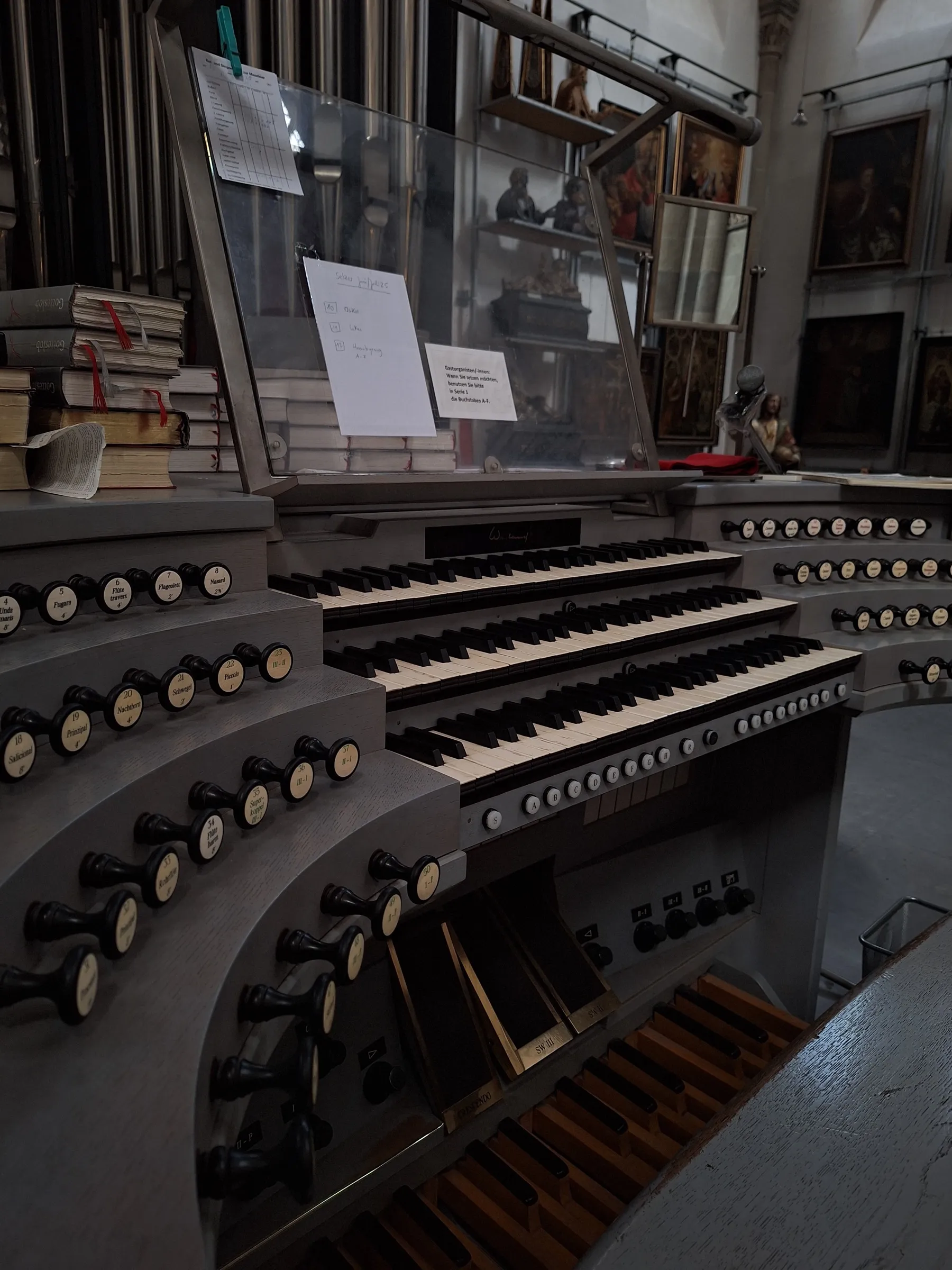
Why this exists
The problem
A couple asks for “Perfect”. They find a piano arrangement online that does not work on the organ — too dense, no pedal, no registration. In the end you improvise.
The consequence
Many part-time colleagues decline modern requests — not for lack of ability, but because the material does not exist and there is no time to set it themselves.
The answer
Two manuals and pedal. Registration written out, for small instruments as well as large ones. And a recording with every setting, so you hear how it is meant before you start practising.
Free
You get my arrangement of “Amazing Grace” — the complete setting as a PDF, together with the MP3 recording. No subscription, no account: one email, and the score is in your inbox.
Common questions
Yes. The arrangements are set for two manuals and pedals, but they can be played on a single manual — the registration guide has a section of its own on exactly that. Three things change: the left hand is thinned out, two or three notes instead of four-part chords. The melody moves up an octave so that it carries. And if there is a swell box, the swell pedal replaces almost every change of stops — and usually sounds more musical doing it. The principle stays the same; only the route there is different.
Every title carries one of three levels. “Very playable” means: if you accompany the congregation on a Sunday, you can read and play the piece. “Intermediate” is the normal case — it takes a few run-throughs, but not weeks of extra practice. “Advanced” marks pieces with running movement where the hands are genuinely busy. I write these arrangements for part-time organists, not for the concert platform. What looks difficult is usually just unfamiliar.
For most arrangements: a week with a few run-throughs. The pieces run from two to nine pages — the short ones you learn in an evening, the longer ones take four or five sittings. The larger part is not learning the notes anyway, it is having the song in your ear. I play a great deal by ear myself: once you have the melody and the chords in your head, you are halfway there.
The complete score as a PDF, the moment you buy. With the organ arrangements the registration guide comes with it — twelve pages on how to build sound, colour and climax on your own instrument, from a one-manual village organ to a large church organ. Some titles include a recording to play along with. No subscription, no account. The files stay available for 30 days.
That depends on how it is set. It turns cheesy when you try to rebuild the band recording — drum figures in the pedals and a tremulant standing in for the voice. The organ cannot do that, and it should not try. What it can do is something else: it has more colours than any other instrument, and a song built on four chords takes on a stillness there that the original recording does not have. I set the pieces so that they sound like an organ — not like a piano with reverb, and not like a backing track.